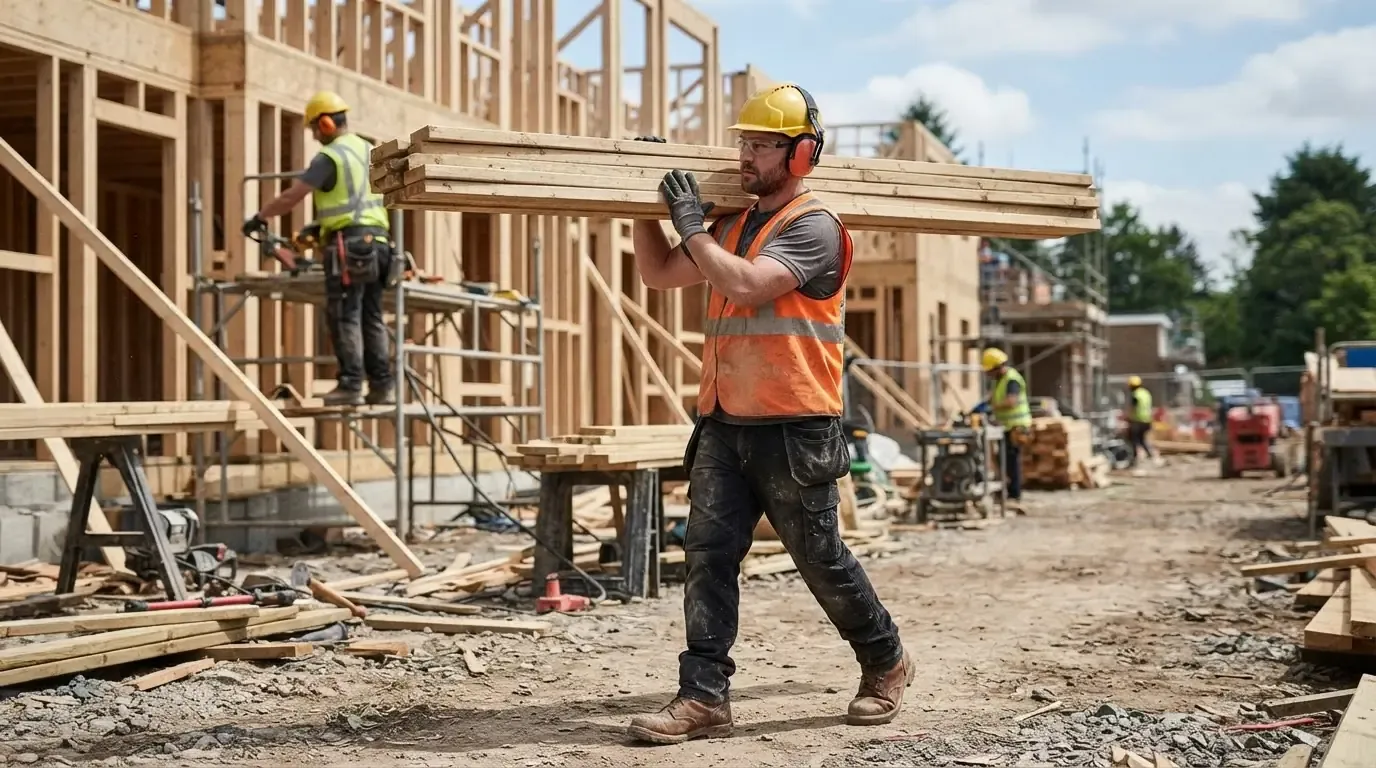
PPE stands for personal protective equipment. OSHA defines it as equipment worn to minimize exposure to hazards that cause serious workplace injuries and illnesses, such as gloves, safety glasses and shoes, earplugs or muffs, hard hats, respirators, coveralls, vests and full body suits. In the US, employers must generally provide it at no cost, with a few listed exceptions.
Key takeaways
- PPE stands for personal protective equipment: gear a worker wears to minimize exposure to chemical, radiological, physical, electrical, mechanical or other hazards (OSHA).
- PPE is the last of five levels in the NIOSH hierarchy of controls, after elimination, substitution, engineering controls and administrative controls.
- Under 29 CFR 1910.132(h) and 1926.95(d), employers provide required PPE at no cost, except listed items such as non-specialty steel-toe boots and prescription safety eyewear that may be worn off the job site.
- Tight-fitting respirators must be NIOSH-certified and fit tested before first use, when the facepiece changes, and at least annually (29 CFR 1910.134).
- Since January 13, 2025, OSHA's construction rule 1926.95(c) states that PPE must be selected to properly fit each affected employee.
Table of contents
PPE stands for personal protective equipment. OSHA defines it as “equipment worn to minimize exposure to hazards that cause serious workplace injuries and illnesses” (OSHA PPE overview). Hard hats, safety glasses, gloves, safety shoes, earplugs and respirators are all PPE.
This guide covers US federal OSHA rules. The main ones are in 29 CFR 1910 Subpart I for general industry and 29 CFR 1926 Subpart E for construction (OSHA construction PPE page). If you work outside the US, your own regulator’s rules apply.
| Question | Short answer | Source |
|---|---|---|
| What does PPE stand for? | Personal protective equipment | OSHA |
| What does it protect against? | “chemical, radiological, physical, electrical, mechanical, or other workplace hazards” | OSHA |
| Common examples | Gloves, safety glasses and shoes, earplugs or muffs, hard hats, respirators, coveralls, vests, full body suits | OSHA |
| When is it required? | When engineering, work practice and administrative controls are not feasible or don’t give enough protection | OSHA |
| Who pays? | The employer, with listed exceptions | 29 CFR 1910.132(h), 1926.95(d) |
| Where does it rank among controls? | Last of five levels | NIOSH |
What does PPE stand for?
The three letters stand for personal protective equipment, and each word matters:
- Personal: it is worn by the individual worker. OSHA’s definition starts with “equipment worn”.
- Protective: it reduces exposure. OSHA’s word is “minimize”, not eliminate.
- Equipment: the range runs from earplugs to full body suits.
The regulation itself uses a wider term. 29 CFR 1910.132(a) covers “Protective equipment, including personal protective equipment for eyes, face, head, and extremities, protective clothing, respiratory devices, and protective shields and barriers.” It must be “provided, used, and maintained in a sanitary and reliable condition” wherever hazards could cause injury “through absorption, inhalation or physical contact.” OSHA’s construction Subpart E summary lists almost the same items for building sites.
In everyday speech, “safety gear”, “protective clothing” and “safety equipment” overlap with PPE. In OSHA’s text, shields and barriers count as protective equipment, but the personal part is what the worker wears.
What are the main types of PPE, and which OSHA rule covers each?
OSHA requires that “many categories of personal protective equipment meet or be equivalent to standards developed by the American National Standards Institute (ANSI).” The table lists the editions OSHA’s rules cite. Newer editions exist; OSHA cites these ones.
| Type | Examples | General industry | Construction | Standard OSHA references |
|---|---|---|---|---|
| Eye and face | Safety glasses, face shields, welding shields | 1910.133 | 1926.102 | ANSI/ISEA Z87.1-2010, ANSI Z87.1-2003 or ANSI Z87.1-1989 (R-1998) |
| Head | Hard hats (protective helmets) | 1910.135 | 1926.100 | ANSI Z89.1-2009, -2003 or -1997, or equipment shown to be at least as effective |
| Foot | Safety-toe shoes and boots, electrical hazard shoes | 1910.136 | 1926.96 | ASTM F-2412-2005 and ASTM F-2413-2005 |
| Hand | Leather, fabric, chemical-resistant and insulating rubber gloves | 1910.138 | 1926.95 (general criteria) | No ANSI glove standard (OSHA 3151) |
| Hearing | Earplugs, earmuffs | 1910.95 (as cited in OSHA 3151) | 1926.101 | Not covered here |
| Respiratory | Dust masks, air-purifying respirators, supplied-air respirators, SCBA | 1910.134 | 1926.103; 1910.134 also applies | NIOSH certification |
| Body | Lab coats, coveralls, vests, jackets, aprons, surgical gowns, full body suits | 1910.132 | 1926.95 | Not covered here |
Eye and face protection
Under 1910.133(a)(1), employers must ensure workers use eye or face protection when exposed to “flying particles, molten metal, liquid chemicals, acids or caustic liquids, chemical gases or vapors, or potentially injurious light radiation.” One common mistake: OSHA 3151 says face shields protect against splashes and sprays “but will not provide adequate protection against impact hazards.”
Head protection
1910.135(a) requires a protective helmet “when working in areas where there is a potential for injury to the head from falling objects.”
Foot protection (safety shoes and work boots)
1910.136(a) requires protective footwear where there is danger from “falling or rolling objects, or objects piercing the sole,” or where footwear protects against an electrical hazard such as static discharge or electric shock. OSHA 3151 notes that electrical hazard safety-toe shoes “can protect against open circuits of up to 600 volts in dry conditions and should be used in conjunction with other insulating equipment.”
Hand protection (gloves)
1910.138(a) covers hazards from “skin absorption of harmful substances; severe cuts or lacerations; severe abrasions; punctures; chemical burns; thermal burns; and harmful temperature extremes.” Selection must be based on the task, the conditions, the duration of use and the hazards identified (1910.138(b)). OSHA 3151 sorts gloves into four groups:
- Leather, canvas or metal mesh
- Fabric and coated fabric
- Chemical- and liquid-resistant
- Insulating rubber
Hearing protection
OSHA 3151 lists single-use earplugs “made of waxed cotton, foam, silicone rubber or fiberglass wool,” plus earmuffs. It also states that at or above 85 dB averaged over eight hours, “the employer is required to institute a hearing conservation program that includes regular testing of employees’ hearing by qualified professionals.”
Protective clothing
OSHA 3151’s body protection examples are “laboratory coats, coveralls, vests, jackets, aprons, surgical gowns and full body suits.” NIOSH adds firefighter turnout gear and healthcare gowns to its examples.
What is respiratory protective equipment?
Respiratory protective equipment means respirators. 29 CFR 1910.134 applies to general industry, shipyards, marine terminals, longshoring and construction. It defines three common types:
| Type | OSHA definition (1910.134(b)) |
|---|---|
| Filtering facepiece (dust mask) | “a negative pressure particulate respirator with a filter as an integral part of the facepiece or with the entire facepiece composed of the filtering medium” |
| Air-purifying respirator | Uses “an air-purifying filter, cartridge, or canister that removes specific air contaminants” from the surrounding air |
| Atmosphere-supplying respirator | Supplies “breathing air from a source independent of the ambient atmosphere”; includes supplied-air respirators (SARs) and self-contained breathing apparatus (SCBA) |
Three rules shape how respirators are used:
- Controls come first. Respirators are used “When effective engineering controls are not feasible, or while they are being instituted” (1910.134(a)(1)).
- NIOSH certification. “The employer shall select a NIOSH-certified respirator” and use it within the conditions of its certification (1910.134(d)(1)(ii)).
- Fit testing. Anyone using a tight-fitting facepiece must be fit tested before first use, whenever a different facepiece size, style, model or make is used, “and at least annually thereafter” (1910.134(f)(2)).
NIOSH summarizes that 1910.134 requires a respiratory protection program with medical evaluations, fit testing and training.
What are some examples of PPE on the job?
Construction PPE
OSHA’s construction PPE page lists separate standards for foot (1926.96), head (1926.100), hearing (1926.101), eye and face (1926.102) and respiratory protection (1926.103). Over all of them sits 1926.95, which requires PPE that is “of safe design and construction for the work to be performed” and that “properly fits each affected employee.”
Welding safety gear
Welders need filter lenses rated for the job. These minimums come from the shade table in 1910.133(a)(5):
| Operation | Arc current | Minimum protective shade |
|---|---|---|
| Shielded metal arc welding | Less than 60 A | 7 |
| Shielded metal arc welding | 250-550 A | 11 |
| Torch brazing | Not applicable | 3 |
| Torch soldering | Not applicable | 2 |
| Carbon arc welding | Not applicable | 14 |
OSHA 3151 describes welding shields as “fitted with a filtered lens” to protect eyes “from burns caused by infrared or intense radiant light,” and leggings that protect “the lower legs and feet from heat hazards such as molten metal or welding sparks.”
Worked example. For example, a fabrication shop welder does shielded metal arc welding below 60 A in the morning and a 250-550 A job in the afternoon. The filter lens must be at least shade 7 for the morning and at least shade 11 for the afternoon. If the welder then switches to torch soldering, the minimum drops to shade 2. Ordinary non-specialty steel-toe boots can be the worker’s own purchase if the employer lets them be worn off the job site (1910.132(h)(2)). The shield and leggings are not among the exceptions quoted in this guide, so check (h)(2) through (h)(6) before asking a worker to pay for them.
Healthcare: PPE for contact and airborne precautions
CDC’s transmission-based precautions are recommendations for healthcare settings, not OSHA regulations:
- Contact precautions: “Wear a gown and gloves for all interactions that may involve contact with the patient or the patient’s environment.”
- Droplet precautions: “Don mask upon entry into the patient room or patient space.”
- Airborne precautions: use “a fit-tested NIOSH-approved N95 or higher level respirator for healthcare personnel.” CDC’s examples include tuberculosis, measles, chickenpox and disseminated herpes zoster.
Labs and chemical handling
Lab coats and aprons are body protection; chemical- and liquid-resistant gloves are one of OSHA’s four glove groups; and 1910.133 requires eye or face protection against liquid chemicals, acids and caustic liquids. Because a face shield alone does not protect against impact, it is not a substitute for impact-rated eye protection.
If your work involves confined space entry, laboratory chemicals or blood exposure, check whether a task-specific OSHA standard applies. This guide covers only the general PPE rules.
When is PPE required, and why is it the last line of defense?
OSHA’s rule of thumb: “When engineering, work practice, and administrative controls are not feasible or do not provide sufficient protection, employers must provide personal protective equipment to their workers and ensure its proper use” (OSHA).
The NIOSH hierarchy of controls ranks options by general effectiveness:
- Elimination
- Substitution
- Engineering controls
- Administrative controls
- Personal protective equipment (PPE)
NIOSH lists three situations for PPE: while other controls are under development, when other controls cannot sufficiently reduce the exposure, and when PPE is the only option. The reason it ranks last is simple: “PPE can be effective, but only when workers use it correctly and consistently.”
Who pays for PPE: the employer or the worker?
The default is the employer. 1910.132(h)(1) says PPE used to comply with the standards “shall be provided by the employer at no cost to employees,” except as listed in (h)(2) through (h)(6). The construction rule, 1926.95(d)(1), uses the same wording.
| Item | Who pays | Rule |
|---|---|---|
| Required PPE (default) | Employer | 1910.132(h)(1) |
| Non-specialty safety-toe footwear, including steel-toe shoes or boots | Not required of employer, if the employer permits them off the job site | 1910.132(h)(2) |
| Non-specialty prescription safety eyewear | Not required of employer, same condition | 1910.132(h)(2) |
| Everyday clothing (long-sleeve shirts, long pants, street shoes, normal work boots) | Not required of employer | 1910.132(h)(4)(ii) |
| Weather gear used only for weather (winter coats, raincoats, rubber boots, ordinary sunglasses, sunscreen) | Not required of employer | 1910.132(h)(4)(iii) |
| Replacement PPE | Employer, unless the worker lost it or damaged it on purpose | 1910.132(h)(5) |
Under 1910.132(h)(6), an employer “shall not require an employee to provide or pay for his or her own PPE” unless it falls under one of those exceptions.
What PPE training does OSHA require?
Before training, the employer must assess the workplace for hazards that call for PPE and “Select PPE that properly fits each affected employee” (1910.132(d)). The assessment is certified in writing, naming the workplace evaluated, the person certifying it, the date(s) and that the document is a certification of hazard assessment.
Training under 1910.132(f)(1) must cover:
- When PPE is necessary
- What PPE is necessary
- How to properly don, doff, adjust and wear it
- Its limitations
- Proper care, maintenance, useful life and disposal
Each worker must “demonstrate an understanding” of the training and the ability to use PPE properly before doing work that requires it (1910.132(f)(2)). “Defective or damaged personal protective equipment shall not be used” (1910.132(e)).
Respirators (1910.134) and electrical protective equipment (1910.137) follow their own rules: paragraphs (d) and (f) of 1910.132 do not apply to them (1910.132(g)).
What changed for construction PPE in 2025?
OSHA’s final rule took effect January 13, 2025. Before it, 1926.95(c) stated “only that all personal protective equipment shall be of safe design and construction for the work to be performed.” The revised text adds that PPE must be “selected to ensure that it properly fits each affected employee” (1926.95(c)(2)), matching the general industry language.
OSHA’s FAQ explains why: poor fit “is particularly important for smaller construction workers, including some women, who may not be able to use standard size PPE.” It also notes that “personal discomfort alone does not rise to the level of an OSHA violation.” A complaint about comfort can still be a reason to check fit.
What to check at your own workplace
- Walk the site against OSHA’s hazard list. OSHA 3151 lists fall hazards, impact, penetration, compression (roll-over), chemical, heat/cold, harmful dust, light (optical) radiation and biologic hazards.
- Try higher controls first. Ask whether each hazard can be eliminated, substituted, engineered out or handled administratively before choosing PPE.
- Certify the hazard assessment in writing with the four items 1910.132(d)(2) requires.
- Match each item to its standard. Check the markings or documentation against the table above, and confirm respirators are NIOSH-certified.
- Check fit for every worker, including smaller sizes, and schedule respirator fit tests at least annually.
- Train and confirm understanding on the five topics before anyone works.
- Inspect and replace. Pull defective or damaged PPE, and budget for replacements the employer must pay for.
- Review who pays against 1910.132(h) or 1926.95(d), and the task-specific standard if one applies.
For questions about your own site, contact OSHA or your state’s OSHA-approved plan; OSHA 3151 notes these state standards must be “identical to, or at least as effective as, the Federal OSHA standards.” A competent safety professional or industrial hygienist can help with the hazard assessment and respirator program. Outside the US, ask your national regulator.
Frequently asked questions
What does PPE mean in workplace safety?
PPE means personal protective equipment. OSHA describes it as equipment worn to minimize exposure to hazards that cause serious workplace injuries and illnesses, from contact with chemical, radiological, physical, electrical, mechanical or other hazards. It is worn by the worker, unlike guards or barriers built into the workplace.
Is a dust mask a respirator under OSHA rules?
Yes. 29 CFR 1910.134(b) defines a filtering facepiece (dust mask) as a negative pressure particulate respirator with the filter built into the facepiece or with the whole facepiece made of filter material. When a respirator is required, the employer must select a NIOSH-certified model and use it within the conditions of its certification.
Does my employer have to pay for my steel-toe boots?
Not always. Under 29 CFR 1910.132(h)(2), the employer is not required to pay for non-specialty safety-toe footwear, including steel-toe shoes or boots, provided the employer permits them to be worn off the job site. Specialty protective footwear is not covered by that exception, and the construction rule 1926.95(d) follows the same no-cost structure.
What PPE is used for contact and airborne precautions in healthcare?
For contact precautions, CDC says to wear a gown and gloves for all interactions that may involve contact with the patient or the patient's environment. For airborne precautions, CDC calls for a fit-tested NIOSH-approved N95 or higher level respirator for healthcare personnel. These are CDC recommendations for healthcare settings, not OSHA regulations.
What safety gear do welders need?
Welders need eye protection with a filter lens of the right shade: the 1910.133 table sets minimum shade 7 for shielded metal arc welding below 60 A and shade 11 at 250-550 A. OSHA's PPE guide describes welding shields with a filtered lens that protect against burns from infrared or intense radiant light, and leggings that protect lower legs and feet from molten metal and welding sparks.
Is uncomfortable PPE an OSHA violation?
Not by itself. OSHA's construction PPE FAQ says some PPE may be inherently uncomfortable and that personal discomfort alone does not rise to the level of an OSHA violation. Poor fit is a different matter: both 1910.132(d)(1)(iii) and 1926.95(c)(2) require PPE that properly fits each affected employee.
Do these PPE rules apply outside the US or in State Plan states?
This guide covers US federal OSHA. OSHA notes that states with approved programs must have standards identical to, or at least as effective as, federal OSHA standards, so some state rules may go further. Workers outside the US should check their own national regulator.
Sources
- Personal Protective Equipment - Overview
- eCFR :: 29 CFR 1910.132 -- General requirements
- eCFR :: 29 CFR Part 1910 Subpart I -- Personal Protective Equipment
- 1926.95 - Criteria for personal protective equipment
- Personal Protective Equipment in Construction (Final Rule)
- Personal Protective Equipment Requirements in Construction Final Rule - Frequently Asked Questions
- Personal Protective Equipment - Construction
- Subpart E - Personal Protective and Life Saving Equipment
- OSHA 3151 Personal Protective Equipment
- About Personal Protective Equipment
- Hierarchy of Controls
- Transmission-Based Precautions
How this guide was made: it was researched and written by Claude, an AI model, from primary sources (regulators, standards bodies) opened during research, and the sources are linked above. Structure, links and metadata pass automated checks. The featured image is AI-generated and illustrative. It has not been reviewed line by line by a named safety professional. about
General information, not legal or professional advice. Rules differ by country, state and industry: check the regulation that applies to your site and ask your regulator or a competent safety professional.